Backbar
A spirits reference and pre-shift trainer for bar teams: scan a bottle, read its producer-sourced facts and the rules of its category, then drill on the back bar before service.
Visit the live site ↗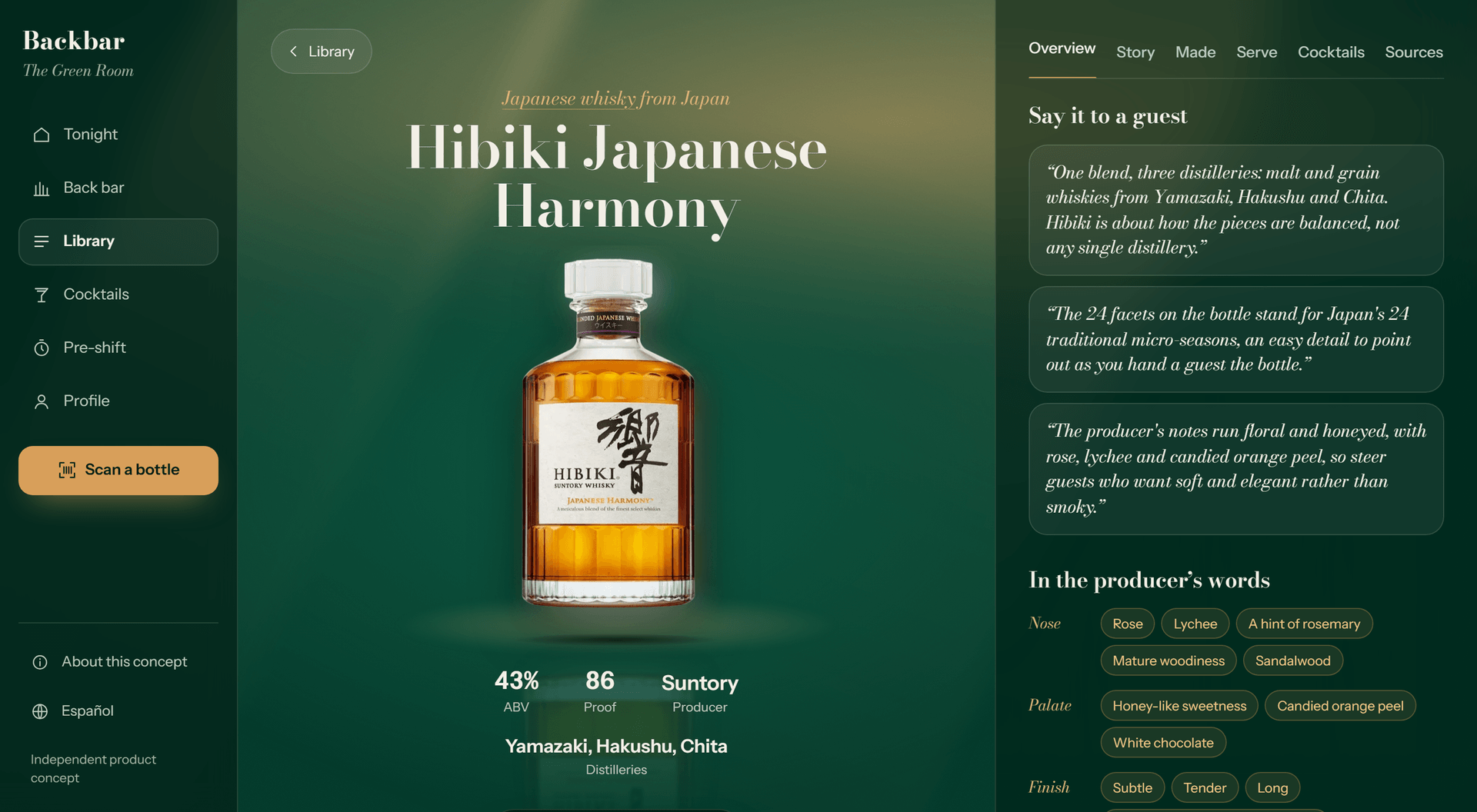
The 30-second version.
A bartender asked about a bottle mid-shift has one free hand, low light and about three seconds, and a plausible guess said to a guest does more harm than no answer.
Designed and built a spirits reference and pre-shift trainer for web and native from one shared package, threw out a clean but flat redesign for an approved mockup, rebuilt both apps from it, then fixed what a real iPhone exposed.
A live demo with no account: 32 bottles with producer-sourced facts, 25 real barcodes, 29 IBA classics and a pre-shift drill, in English and Spanish, with every unknown field left empty. It began as a concept, and it is still in development: Alvaro, Jose and I are now working to make it a real product.
- Sourced bottles
- 32
- IBA cocktails
- 29
- Real barcodes
- 25
- Unit tests
- 468
Three seconds, one hand, low light.
A guest asks about a bottle and the bartender has a moment between tickets to answer. The answer has to be quick to read and safe to repeat, because a confident guess sounds exactly like a fact.
- Who: bartenders and barbacks mid-shift, bar directors training a team, and brand ambassadors who need a page they can stand behind.
- Where: behind the bar, on a phone, in English or Spanish.
- Constraint: every fact needs a source: the producer, or the law that defines its category.
- Risk: a page that looks complete because its gaps were filled in.
What I owned.
What I owned
- Product direction: grew the idea into the product and set the sourcing rule
- Visual and interaction design, web and native
- Catalog pipeline, shared package and both apps
- Device testing on a real iPhone
Who I worked with
- Alvaro Ferreira, who had the original idea
- Jose Reyes, a bartender at KRU in Sacramento, where I worked as a host, server assistant and barback through university. He took the app to working bartenders and brought back what held up behind the bar
How it came together.
Audit, then a miss
The first version worked but read as generic: all-caps eyebrows, monospace meta, identical boxes, white-backed photos on green. A cleaner redesign on cream cards was turned down: no depth, no personality.
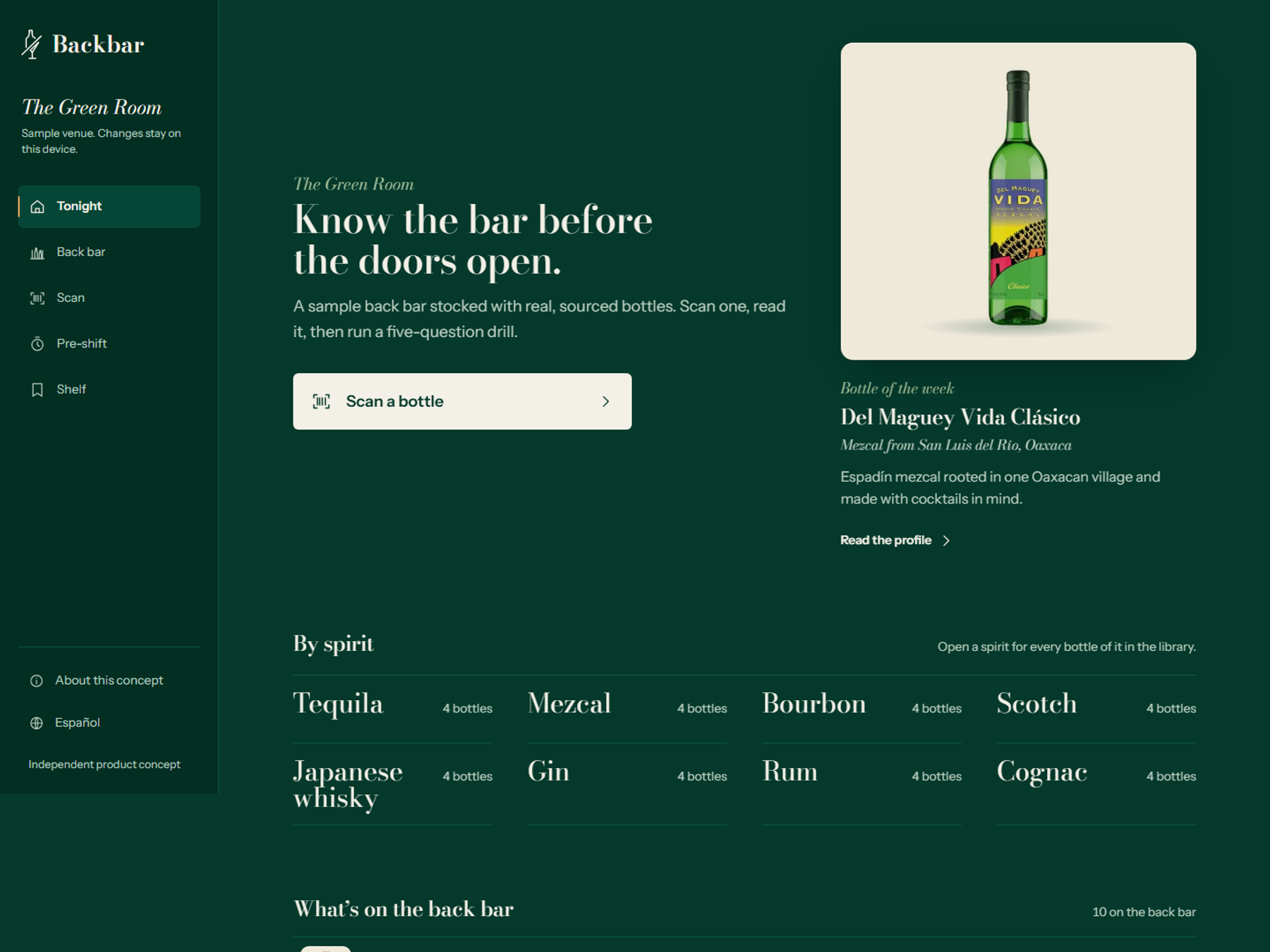
Approve a mockup first
References first (products in coloured light, glass sheets, tactile drink cards), then a clickable mockup approved before any rebuild: each bottle in amber light on deep green glass.
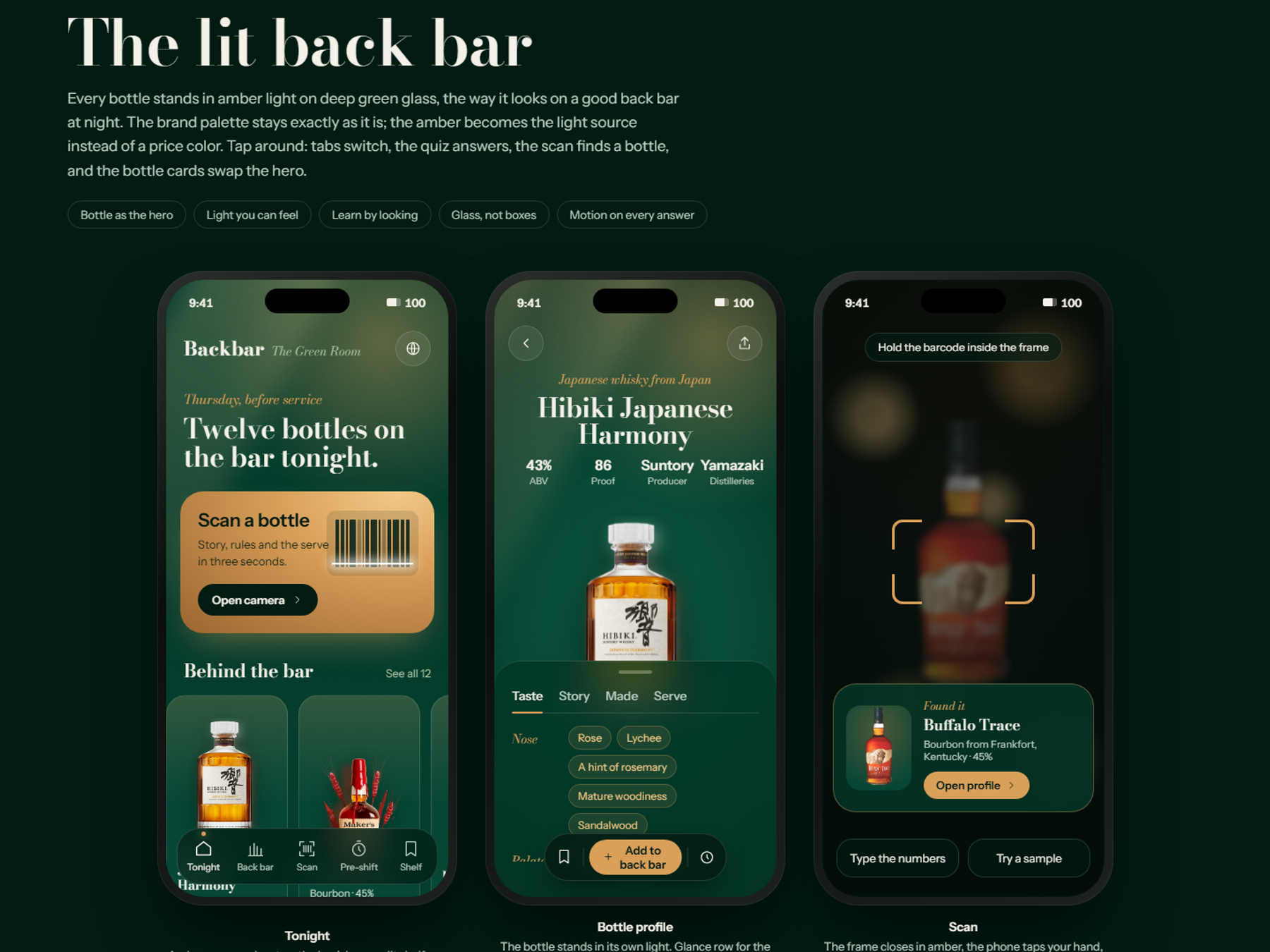
Rebuild both apps
Both apps rebuilt from the mockup. An edge flood-fill cut the bottle photos out without losing clear glass, and category law became visuals: strength windows, age ladders, method tiers.
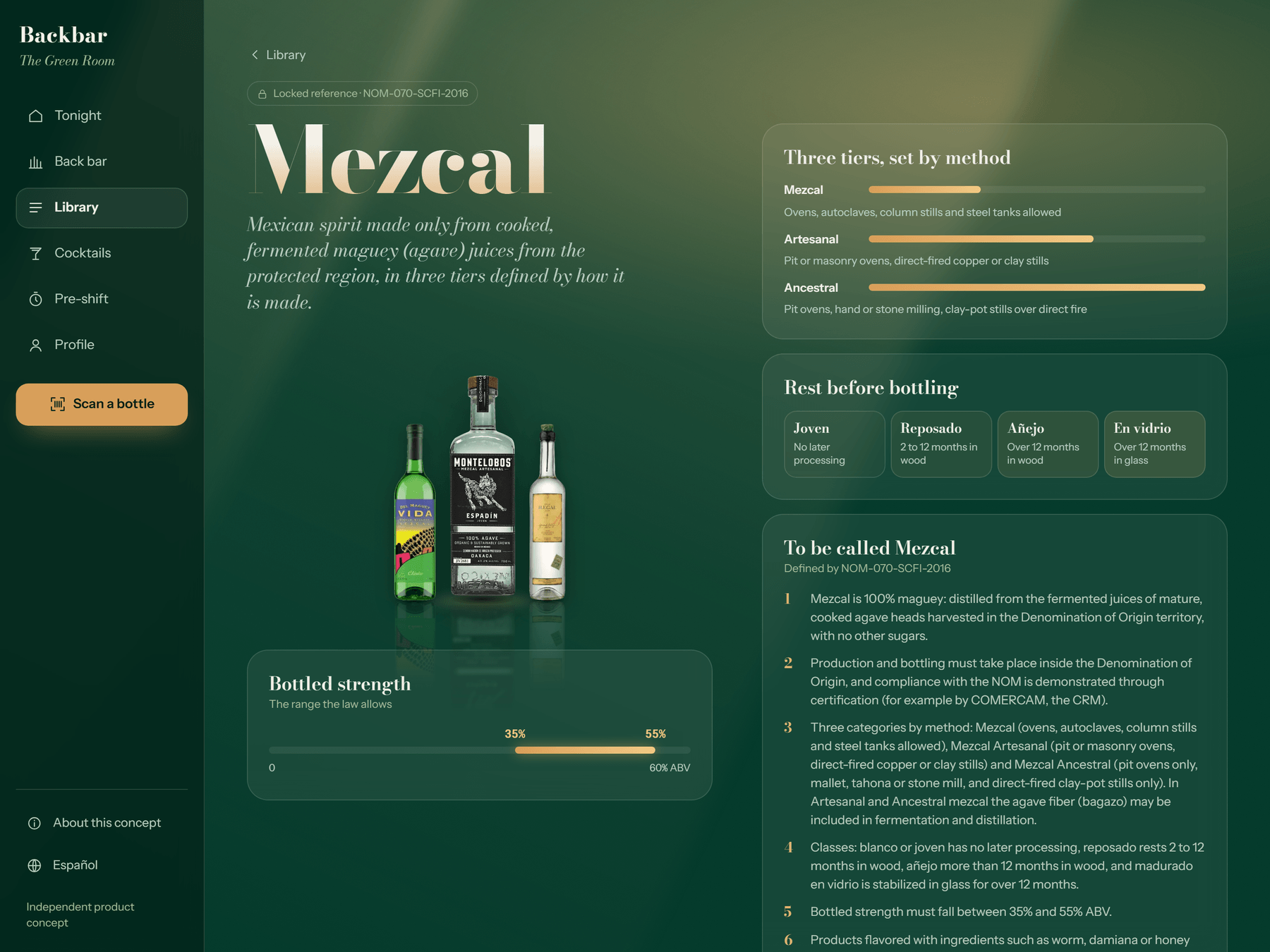
Test on a real iPhone
Rows fine on the web collapsed on the phone: NativeWind dropped function-style styles on Pressable. One Press component and a test now guard it, alongside SDK 58, taller Bodoni line heights and a solid header.
Add from feedback
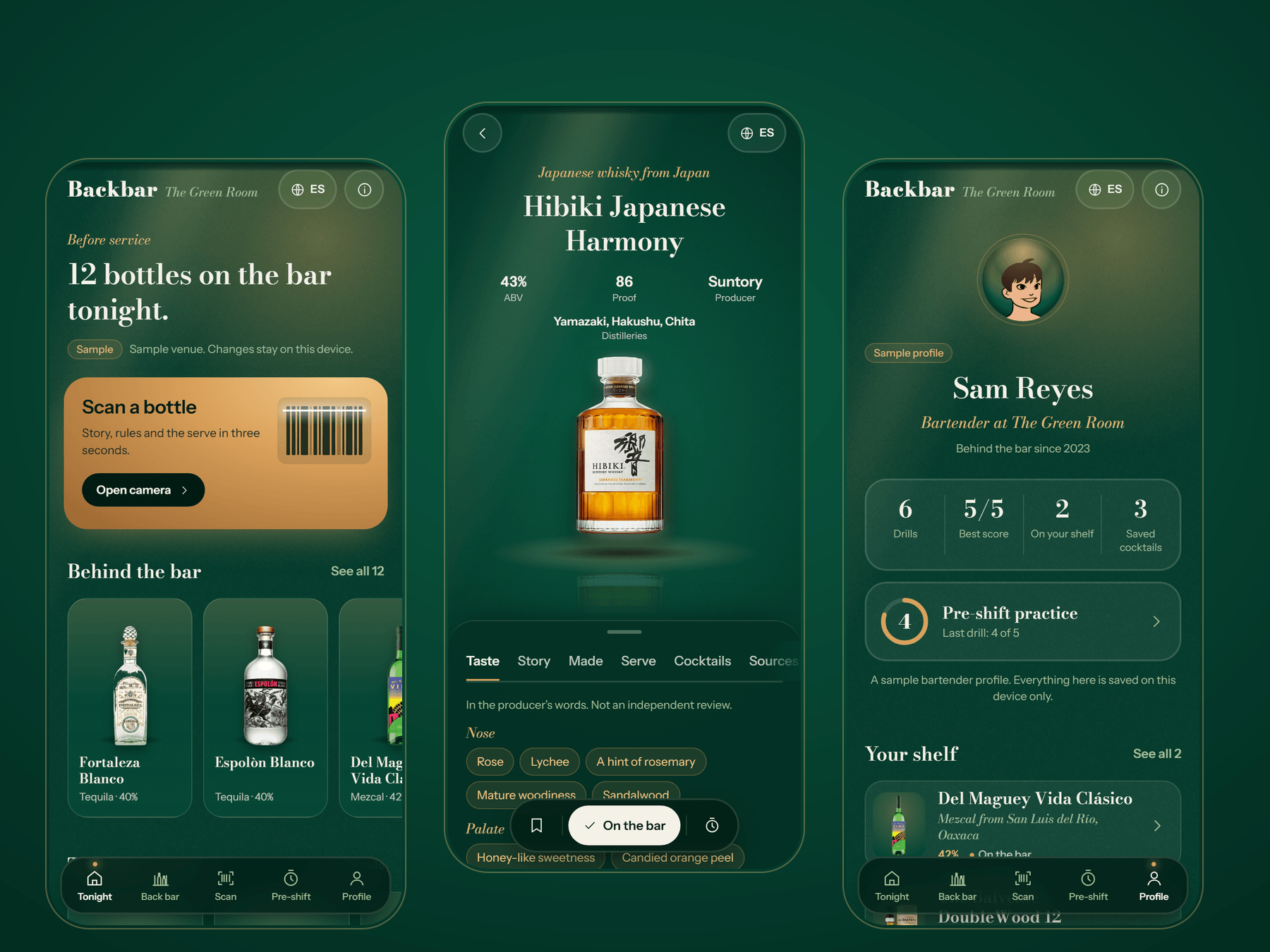
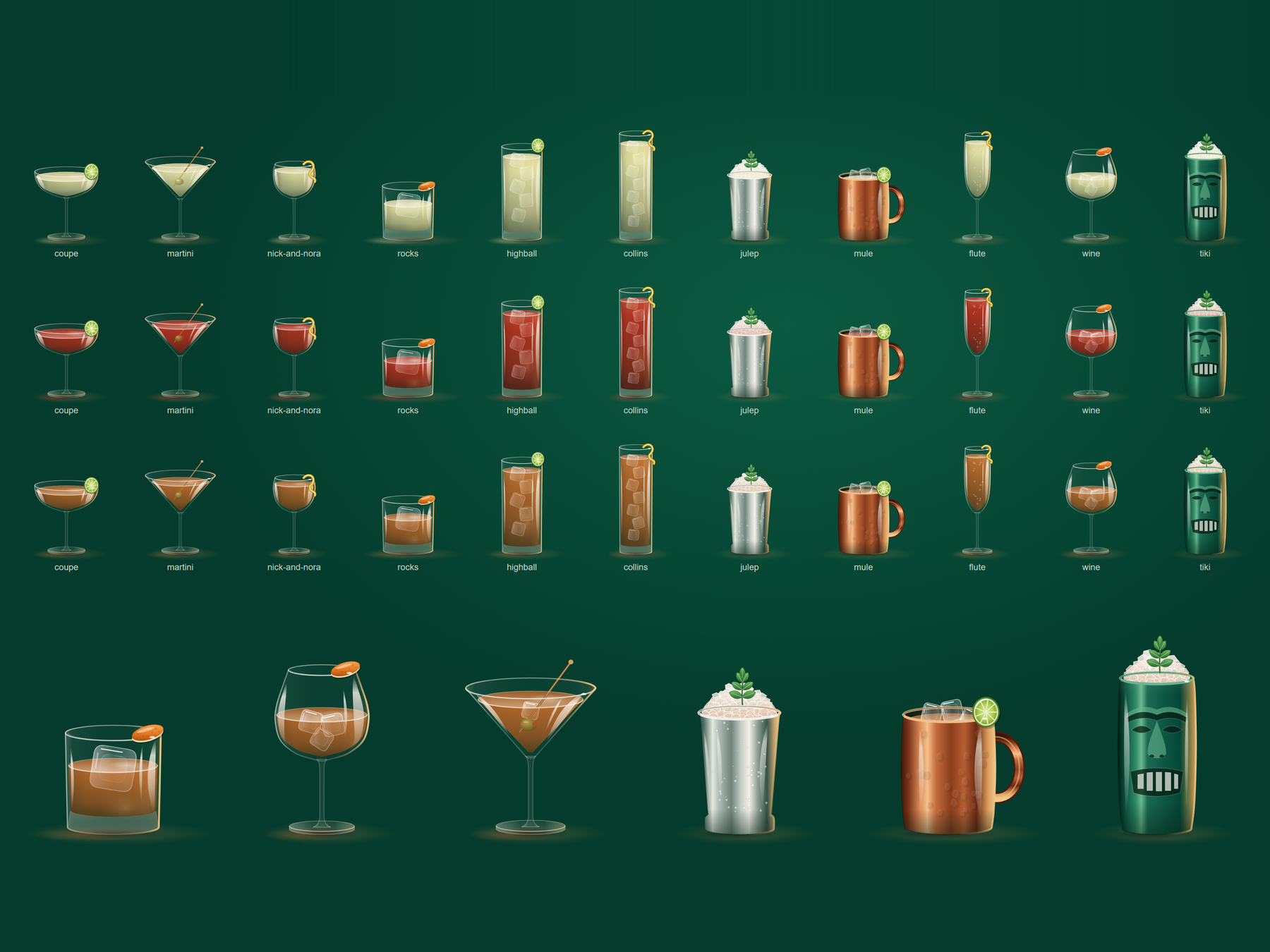
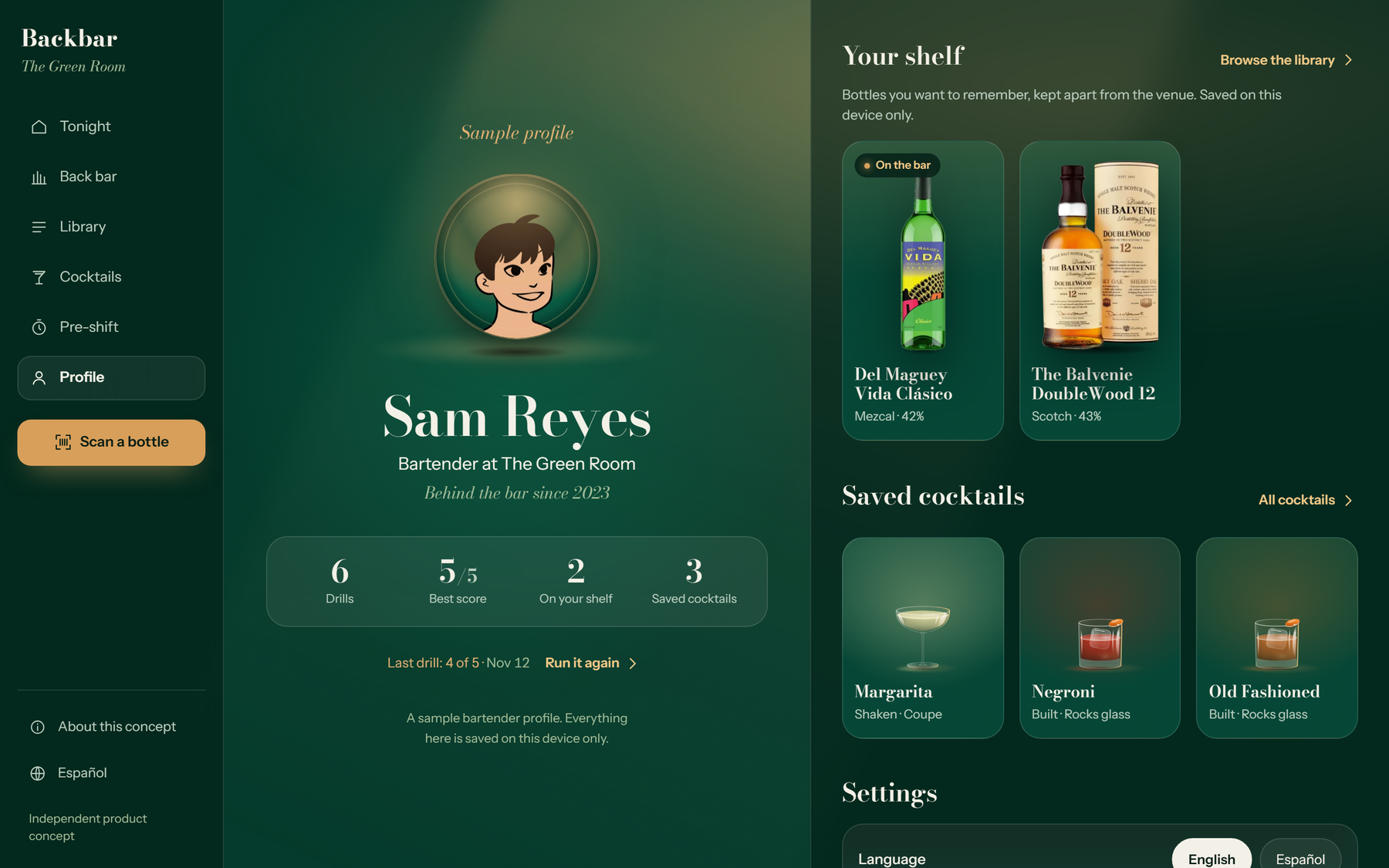
A sample bartender profile with drill history, shelf and saved cocktails, and IBA classics in glassware drawn once for web and native.
A blank is better than a guess.
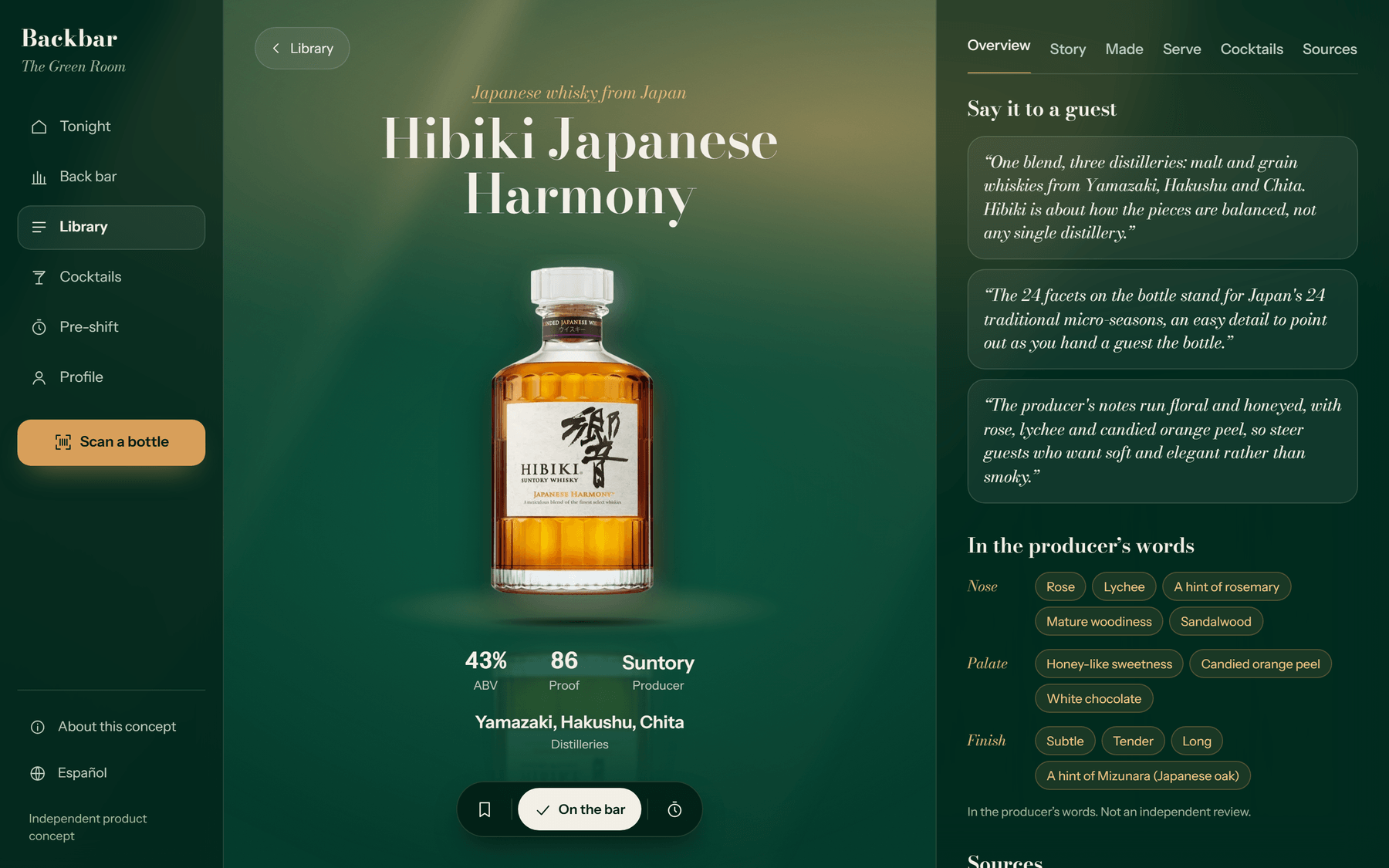
Unknown fields stay empty, and tasting notes are credited to the producer who wrote them. An independent fact-check of every category rule caught six errors before release, among them mezcal’s minimum strength: 35%, not 36%.
One cited source for every cocktail.
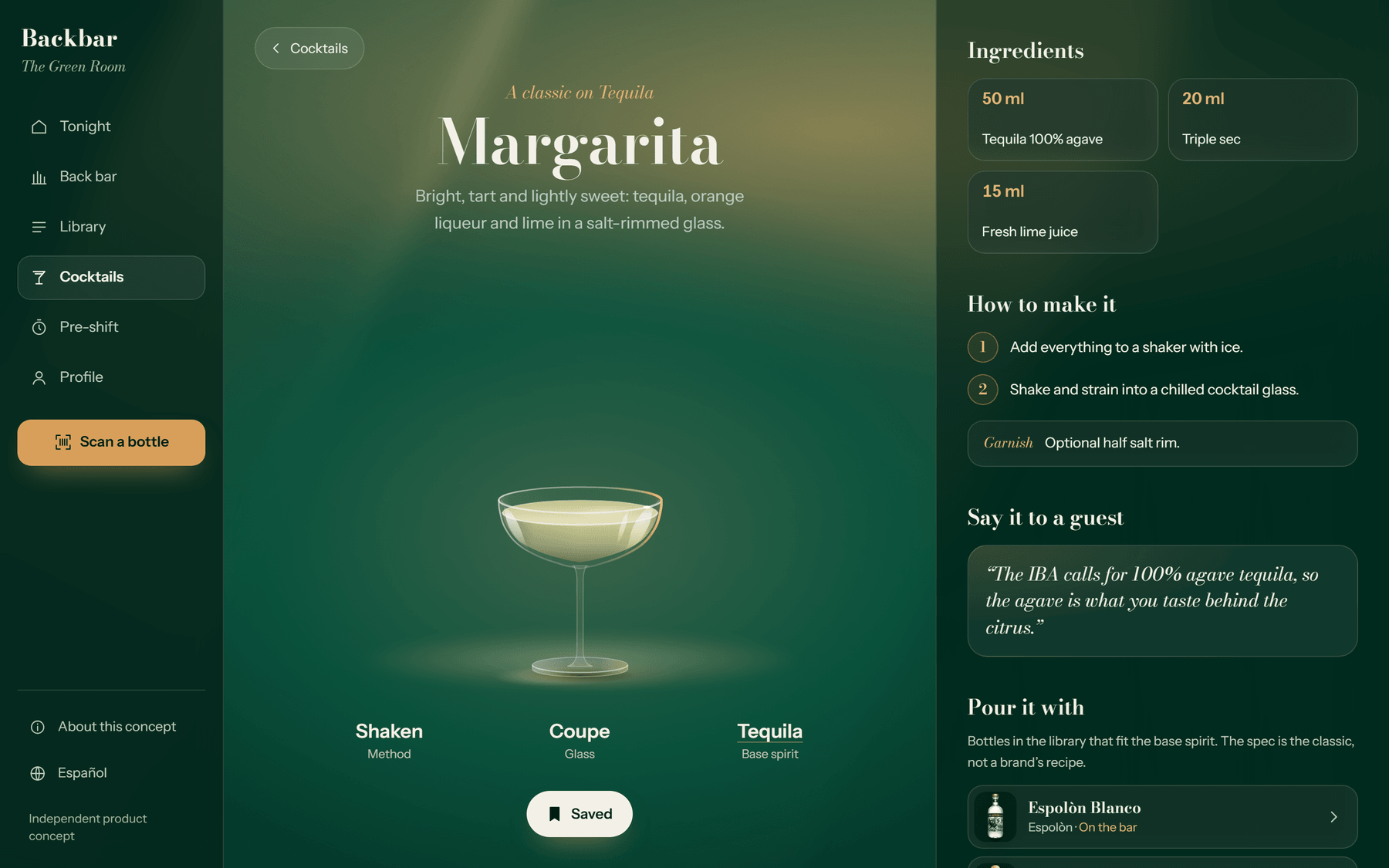
The 29 classics come from the International Bartenders Association’s official list, each served in its own illustrated glass. Japanese whisky has none, because no IBA spec names it.
Train on the shelf you pour from.
Pre-shift drills come from a venue’s own back bar, not the whole catalog. The demo’s sample bartender profile shows the loop: drill history, a personal shelf and saved cocktails, kept on the visitor’s device.
What I chose, and what it cost.
Open any decision to see the alternative and the price I paid for it.
What shipped.
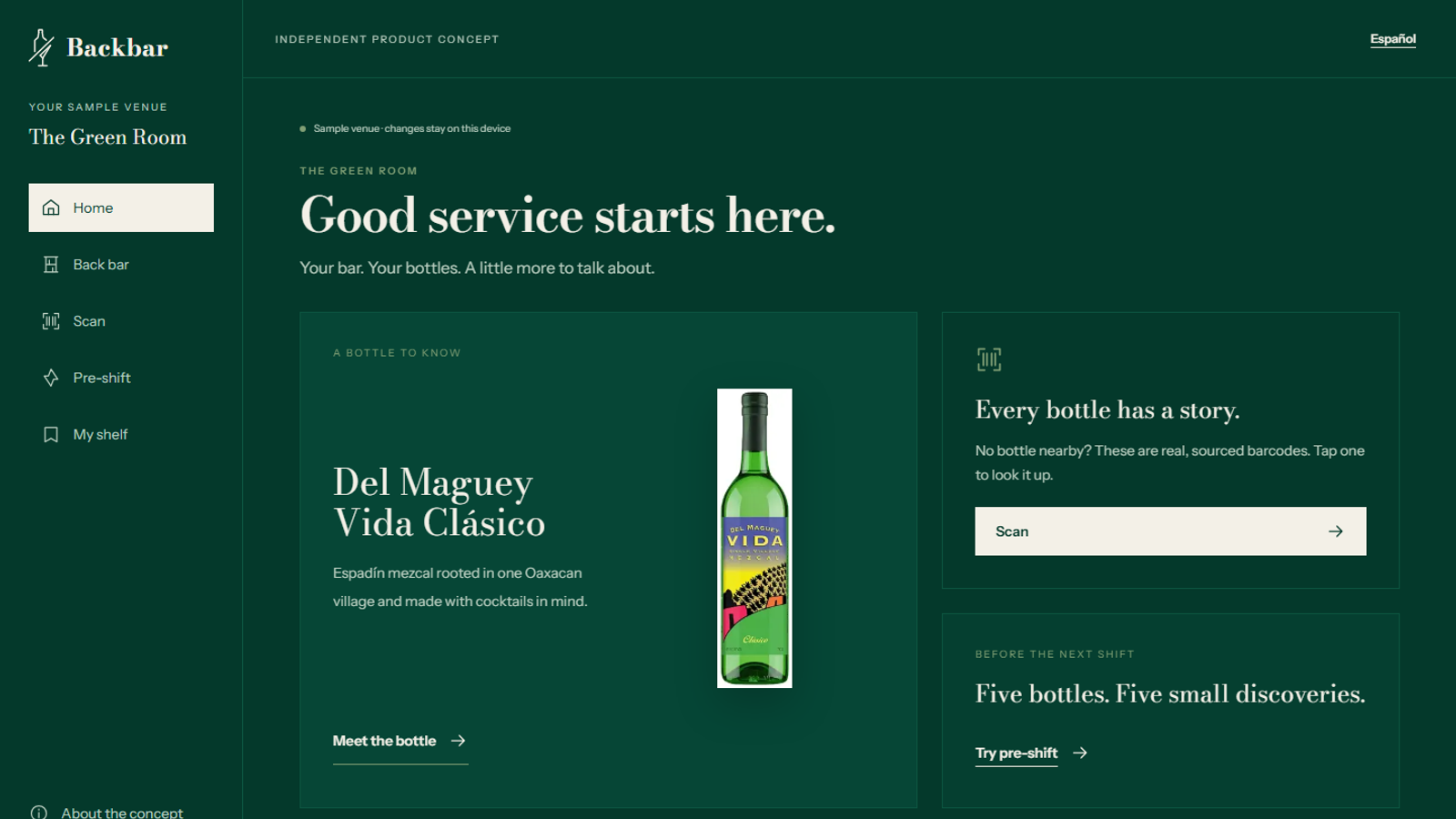
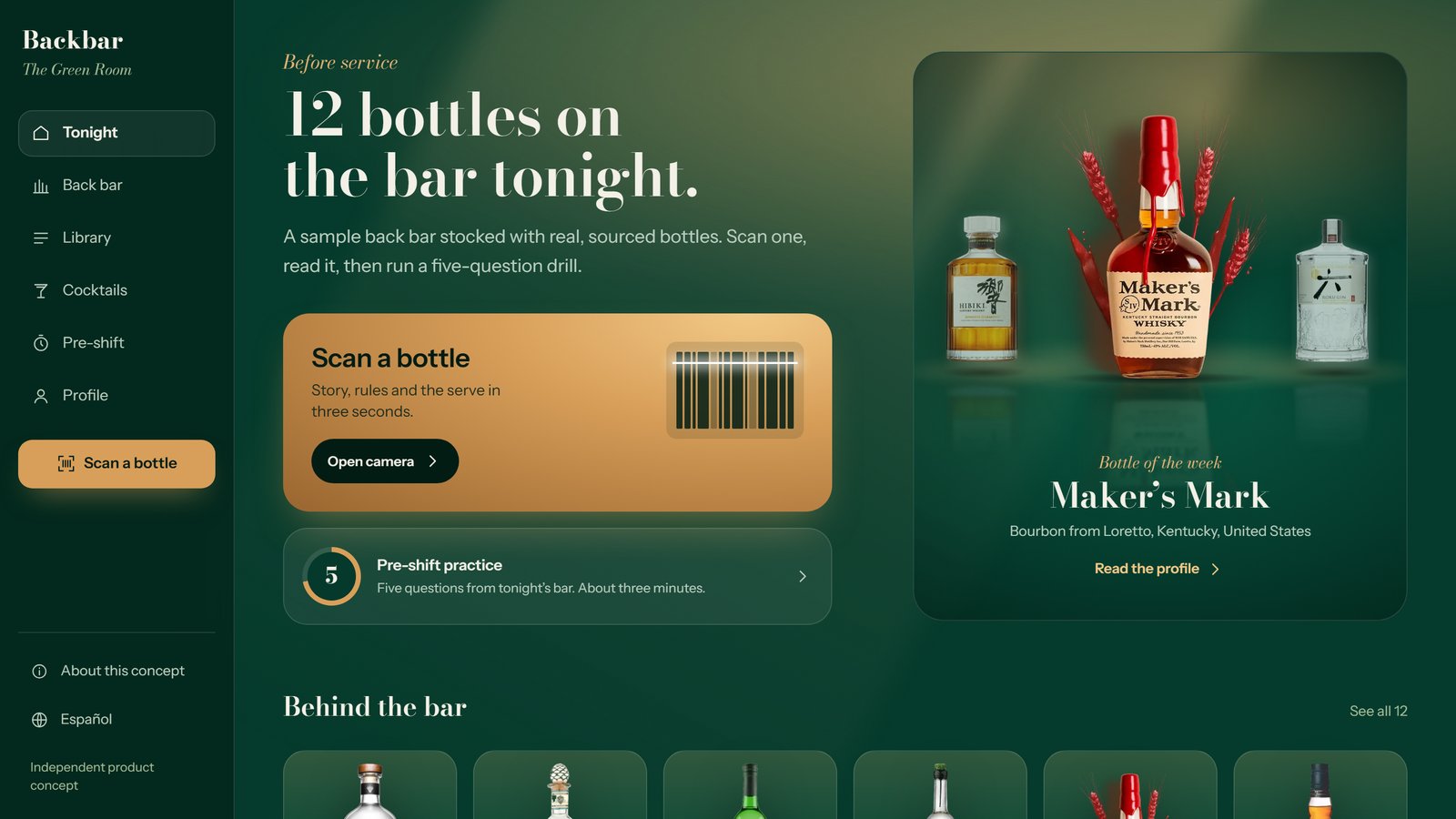 BeforeAfter
- Errors caught by an independent fact-check before release
- 6
- Platforms from one shared TypeScript package
- 2
- Row-level security policies on the venue app
- 61
- SourceCited research bundlesZod-validated, generated into one catalog
- Shared@backbar/sharedTokens, catalog, EN/ES strings, barcodes, glassware
- AppsNext.js web + Expo nativeSame data and art; venue app on Supabase with RLS
An npm workspaces monorepo holds three parts. A pure TypeScript package carries the design tokens, the Zod-validated catalog, every English and Spanish string, the barcode normalizer and the glassware drawings, and both apps import it rather than copy it. The web app is Next.js App Router with Tailwind; the native app is Expo SDK 58 on React Native 0.88, with expo-router, Reanimated and NativeWind. Scanning is split by platform: the native BarcodeDetector on Chromium, a lazily loaded WASM zxing decoder on iOS Safari and expo-camera on native, with manual entry always available. The catalog starts as cited research bundles, passes Zod validation and is generated, while an asset pipeline downloads, cuts out and optimizes the bottle images. The signed-in venue app runs on Supabase, where 61 row-level security policies across 27 migrations keep house notes and pour prices inside each venue; the public demo never touches it. 468 unit tests cover the shared package and the native app, and layout shift stays at or under 0.02 on every demo route.
- Next.js
- TypeScript
- Expo
- React Native
- NativeWind
- Reanimated
- Tailwind
- Supabase
- PostgreSQL
- Zod
What I'd change, and what I'd keep.
I'd do differently
Set up EAS builds from the start, for a public phone demo and real-device QA inside the loop rather than after it: the collapsed native screens only showed up on an actual iPhone.
I'd keep
The sourced-or-empty rule, and one shared package feeding both apps.
Open to full-time product design and full-stack development roles. Let's build something people rely on.
javiertpga@gmail.com